
How Secure Is Incognito?
Incognito mode improves local privacy, but it doesn’t make you anonymous online. Learn what Incognito mode actually protects and what it cannot hide.
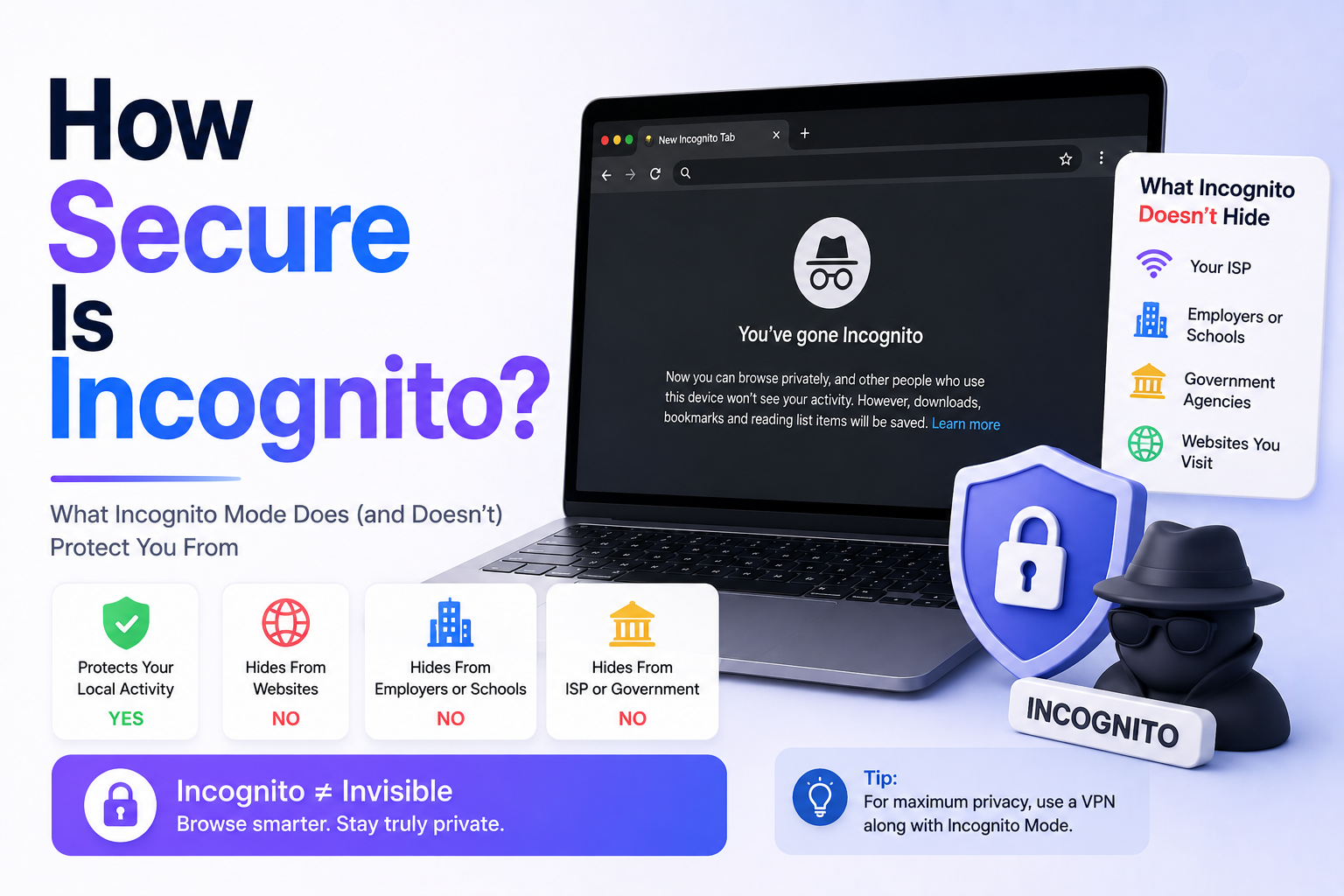
How Secure Is Incognito?
Incognito Mode is one of the most commonly misunderstood privacy features on the internet.
Many people believe that using Incognito Mode makes them completely anonymous online or hides all their browsing activity. In reality, Incognito Mode provides limited privacy protection and does not make you invisible on the internet.
So how secure is Incognito really?
The short answer: it helps protect local privacy on your device, but it does not fully hide your activity from websites, internet providers, employers, schools, or online tracking systems.
In this guide, we’ll explain what Incognito Mode actually does, what it protects, what it doesn’t protect, and how to improve your online privacy.
What Is Incognito Mode?
Incognito Mode is a private browsing feature available in browsers like:
- Google Chrome
- Microsoft Edge
- Safari
- Firefox
Different browsers use different names:
- Chrome: Incognito Mode
- Firefox: Private Browsing
- Edge: InPrivate Browsing
- Safari: Private Browsing
The purpose of Incognito Mode is to reduce the amount of browsing data stored locally on your device after your session ends.
What Incognito Mode Actually Does
When you use Incognito Mode, your browser typically does not save:
- Browsing history
- Search history
- Cookies after the session ends
- Form data
- Autofill entries
- Temporary browsing information
Once all Incognito windows are closed, most locally stored session data is removed.
This can be useful if:
- You share a computer
- You use a public device
- You don’t want local browsing history saved
- You want to log into multiple accounts at once
What Incognito Mode Does NOT Hide
This is where many misconceptions begin.
Incognito Mode does not make you anonymous online.
Your Internet Provider Can Still See Activity
Your ISP may still see:
- Websites you visit
- Connection times
- Data usage
- Internet traffic patterns
Incognito Mode does not encrypt your internet traffic.
Websites Can Still Track You
Websites can still collect information such as:
- Your IP address
- Browser fingerprint
- Device type
- Account activity
- Location information
If you log into accounts like Google, Facebook, Amazon, or YouTube, those services can still track activity associated with your account.
Employers and Schools May Still Monitor Activity
If you use:
- Work devices
- School networks
- Managed Wi‑Fi
…your browsing activity may still be visible to administrators.
Incognito Mode does not bypass network monitoring systems.
Downloads and Bookmarks Still Remain
Incognito Mode does not remove:
- Downloaded files
- Saved bookmarks
- Screenshots
- External logs
Anything you manually save remains on the device.
Incognito Mode vs VPN
Many people confuse Incognito Mode with VPN services.
They are completely different tools.
Incognito Mode
Incognito Mode:
- Prevents local history storage
- Deletes cookies after sessions
- Improves local privacy
But it does NOT:
- Hide your IP address
- Encrypt internet traffic
- Hide activity from your ISP
VPN
A VPN:
- Encrypts internet traffic
- Hides your IP address
- Improves network privacy
- Helps protect activity on public Wi‑Fi
However, a VPN still does not make you completely anonymous online.
Is Incognito Mode Safe?
Yes — but only for certain types of privacy.
Incognito Mode is useful for:
- Preventing local history storage
- Using shared computers
- Testing websites
- Logging into multiple accounts
- Reducing temporary tracking cookies
But it should not be relied on for:
- Full anonymity
- Hiding activity from networks
- Bypassing monitoring
- Complete online privacy
Common Myths About Incognito Mode
Myth 1: Incognito Makes You Anonymous
False.
Websites, apps, internet providers, and networks may still see activity.
Myth 2: Incognito Prevents Viruses
False.
Incognito Mode does not protect against:
- Malware
- Phishing scams
- Dangerous downloads
- Fake websites
Myth 3: Google Can’t See Your Activity
False.
If you’re logged into a Google account, activity may still be associated with your account.
Myth 4: Incognito Hides Everything From Employers
False.
Workplace and school networks may still monitor internet usage.
How to Improve Privacy Beyond Incognito
If you want stronger privacy online, combine Incognito Mode with other tools and habits.
Use a VPN
VPNs help encrypt internet traffic and reduce network visibility.
Use Privacy-Focused Browsers
Some browsers include stronger tracking protection features.
Enable Tracker Blocking
Ad blockers and anti-tracking extensions can reduce tracking.
Clear Cookies Regularly
Deleting cookies reduces persistent website tracking.
Use Strong Passwords
Protect accounts with unique passwords and two-factor authentication.
Avoid Oversharing Online
Limit the personal information you share publicly.
When Should You Use Incognito Mode?
Incognito Mode is useful when:
- Using shared devices
- Logging into multiple accounts
- Shopping for gifts secretly
- Reducing local browsing traces
- Testing websites
- Avoiding temporary cookies
It’s a convenient privacy feature — just not a complete security solution.
Final Thoughts
Incognito Mode improves local privacy, but it does not make you invisible online.
Your internet provider, websites, employers, schools, and online services may still collect information about your activity.
Think of Incognito Mode as a tool for reducing local browsing traces rather than a full privacy or security solution.
For stronger online privacy, combine Incognito Mode with safe browsing habits, strong passwords, tracking protection, and other privacy tools like VPNs and secure browsers.
Keep reading
Related posts

How to Delete a Reddit Account (Complete Step-by-Step Guide)
Learn how to permanently delete your Reddit account on desktop and mobile, remove Reddit posts and comments, and protect your privacy before deactivating your account.

How to Delete Cookies on Any Browser (Chrome, Safari, Firefox & Edge)
Learn how to delete cookies on Chrome, Safari, Firefox, Edge, Android, and iPhone. Step-by-step guide to clearing browser cookies, improving privacy, and fixing website problems.

How to Delete Apps on iPhone (Complete Guide for iOS)
Learn how to delete apps on iPhone, remove hidden apps, uninstall apps permanently, free up storage space, and manage app data on iOS devices.